CDCF — Catholic Digital Commons Foundation

Symbolism of the CDCF Logo
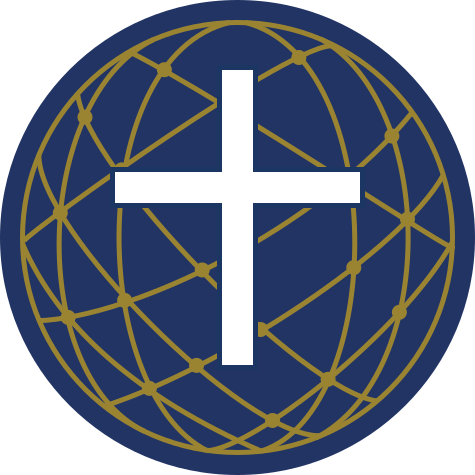
CDCF Logo

The central vision: Christus Rex

The foundational concept of the Catholic Digital Commons Foundation logo is the enduring sovereignty of Christ, visually expressed by the Cross superimposed upon a Globe. This core image declares a single theme: Christ is King — His dominion is universal, and His mission extends to the whole world.

The Cross of Christ is the supreme symbol of God’s sacrificial love and the instrument of humanity’s redemption. Its placement over the globe signifies that Christ’s Kingship is not confined to a single nation, people, or era, but is universal and absolute. The authority of Christ, established through His death and resurrection, extends over all creation, all of history, and all of humanity.

This image also recalls the vision of Emperor Constantine before the Battle of the Milvian Bridge in 312 AD, when he saw the Cross in the sky with the words “In hoc signo vinces” — “In this sign you shall conquer.” That vision marked a turning point in history: Constantine’s subsequent embrace of Christianity opened the way for the faith to spread freely throughout the Roman Empire and, from there, to the entire world. The cross over the globe thus evokes not only Christ’s eternal Kingship but also the historical moment when the Cross became the standard under which Christianity advanced into the global space.

The three elements

1. The Cross

The Cross

A bold, white Latin cross occupies the center of the emblem. It is the primary focal point and the element from which the rest of the composition derives its meaning.

The cross is rendered with clean, straight edges and no serifs—simple and unadorned, reflecting the clarity and directness of the Gospel message.

2. The Globe

The Globe

The globe represents the totality of the world in its geographical and temporal fullness. By crowning it with the cross, the logo declares that Christ’s Lordship is the ultimate reality and the central principle by which all things are ordered.

The globe also underscores the international character of the CDCF, conveying that the Foundation is not confined to any one region but is inherently global in its membership, vision, and mission.

3. The Net

The Net

Overlaid upon the globe is a network of intersecting arcs and lines, with nodes at their intersections. This net carries a rich, threefold symbolic meaning:

  • The biblical mandate of evangelization. The net is a direct reference to Christ’s call to His disciples: “I will make you fishers of men” (Matthew 4:19). It represents the Church’s perennial mission to cast the net of the Gospel across the whole world.

  • Global digital connectivity. In a contemporary context, the net represents the internet — the digital infrastructure that connects humanity across every boundary. This acknowledges the central role of modern communication technology in facilitating the Church’s outreach and the Foundation’s own work.

  • Artificial intelligence and neural networks. The interwoven structure of nodes and connections evokes the architecture of neural networks, the computational foundation of modern artificial intelligence. This element signals the Foundation’s commitment to engaging thoughtfully and ethically with emerging technologies as instruments of mission and dialogue.

We must lay one brick at a time, take one step at a time… But we can beg for an increase of love in our hearts that will vitalize and transform all our individual actions, and know that God will take care of them and multiply them, as Jesus multiplied the loaves and fishes.

— Dorothy Day, Loaves and Fishes (1963)

Visual description

The logo takes the form of a circular emblem (roundel) composed of two principal layers:

  • Background layer: A deep navy-blue disc representing the globe, overlaid with a stylized geodesic grid rendered in gold. The grid lines intersect at small, solid circular nodes, forming the network motif.

  • Foreground layer: A solid white Latin cross, centered and superimposed over the globe and net.

Color palette

The logo employs three colors, each chosen for both visual clarity and symbolic resonance:

Color Element Symbolism
Navy blue Globe (background disc) The sea and the deep; longevity, life, and the breadth of humanity
Gold / ochre Network grid and nodes Value, divine light, and connectivity
White Cross Purity, truth, and the light of Christ

Press kit

Download the official CDCF logo assets — including vector SVG, PNG, and individual element files — as a single archive:

Download press kit (zip)

Technical specification

Element Description
Shape Circular / roundel
Primary icon Latin cross (centered)
Background motif Geodesic grid with nodes
Design style Flat design with high legibility

Did you notice the fish in the net? Guess how many there are.

The Symbolism of 24

The Symbolism of 24

The number 24 holds symbolic significance in the New Testament, particularly in the Book of Revelation, where it appears as the 24 elders seated on thrones around God’s heavenly throne. This imagery evokes the fullness of the heavenly court and the redeemed community (the Church triumphant), often interpreted as a doubling of the number 12—representing the 12 tribes of Israel (Old Covenant) united with the 12 apostles (New Covenant).1 2 3 Patristic writers and tradition view it as signifying completeness in worship and the eternal praise of the saints before God.4 5 6

Biblical Appearances in Revelation

The 24 elders are described in vivid apocalyptic visions of heavenly liturgy:

Around the throne are twenty-four thrones, and seated on the thrones are twenty-four elders, dressed in white robes, with golden crowns on their heads.7

These elders worship the Lamb (Christ), holding harps (symbolizing praise) and golden bowls full of incense, which are explicitly the prayers of the saints:

When he had taken the scroll, the four living creatures and the twenty-four elders fell before the Lamb, each holding a harp and golden bowls full of incense, which are the prayers of the saints.8

They cast their crowns before the throne, proclaiming God’s worthiness and creative power (Rev 4:10–11; 5:9–14). This scene underscores the elders as representatives of the sanctified people of God, bridging earthly prayer and heavenly reality.9

While Revelation 7 mentions the 144,000 sealed (12 × 12 × 1,000, symbolizing the complete number of the elect), it builds on the 24 elders’ motif without repeating the number directly.10 11

Patristic and Traditional Interpretations

Early Church Fathers saw numbers like 12 and its multiples (e.g., 12 × 12 = 144) as “legitimate” symbols favored in Scripture, denoting universal time, the whole body of saints, or the Church’s fullness rather than mere chronology.12

  • Victorinus of Poetovio explicitly links the 24 elders to the division of day and night: “there are appointed also twelve angels of the day and twelve angels of the night… these are the twenty-four witnesses of the days and nights which sit before the throne of God… whom the Apocalypse… calls elders.” He ties this to the 12 hours of day/night, months, years, and cosmic order, portraying them as ancient angelic witnesses older than humanity.13

  • St. Augustine emphasizes 12’s recurrence (tribes, apostles) and its squares/multiples for the complete number of the elect (e.g., 144,000 in Rev 7:4 as “the whole body of the saints”). While not detailing 24, he notes such numbers apply broadly “to men” and the Church’s sojourn.14

The Catholic Encyclopedia affirms that Scripture’s numbers (7, 12, 40, etc.), especially in the Apocalypse, carry mystical meaning interpreted by the Fathers as an essential exegetical tool—distinct from condemned pagan numerology. The 24 elders exemplify this in heavenly worship, influencing liturgical numbers (e.g., 24 divisions of priests in 1 Chron 24 echoed in Christian rites).15

Relation to the Church and Christian Community

The doubling of 12 aligns with traditional exegesis: the 24 elders symbolize the Church in its totality—Old Testament Israel (12 tribes) plus New Testament apostles (12), crowned in glory and interceding via the saints’ prayers. This reflects the Church as a priestly people (1 Pet 2:9; Rev 1:6), participating in eternal liturgy.16 17 18 It is not speculative but rooted in Revelation’s typology, where heaven mirrors and perfects the earthly assembly.

In summary, 24 signifies the complete, crowned assembly of God’s people in worship, uniting covenants through the doubled 12. This invites the Christian community to see itself in the elders’ praise and prayer.19 20 21 22 23

24 in Computer Science

The number 24 also holds a distinctive place in computing. Its significance is emergent rather than axiomatic—24 is not a power of two, nor a CPU word size—but it sits at the exact intersection of machine efficiency and human perception.

The fundamental reason is simple: 24 bits = 3 bytes. This is the smallest byte-aligned unit large enough to represent high-fidelity, human-oriented data without waste.

  • 24-bit color (Truecolor). The standard for digital displays allocates 8 bits each to Red, Green, and Blue, yielding 16,777,216 colors—enough to exceed the human eye’s discriminative ability. Anything less looks visibly banded; anything more was historically wasteful. This is why 24-bit RGB became the universal standard for displays, images, and graphics pipelines.

  • 24-bit audio. In professional recording, 24-bit samples provide approximately 144 dB of dynamic range—far beyond the 96 dB of consumer 16-bit audio. The extra headroom reduces quantization noise and allows generous margins during mixing and mastering. Three bytes per sample is the industry sweet spot.

  • A computationally friendly number. Beyond its byte alignment, 24 is highly composite (divisible by 1, 2, 3, 4, 6, 8, 12), making it naturally suited for splitting across channels, fields, and data buses. It packs efficiently into memory structures even when strict binary alignment is not required.

For a foundation dedicated to the digital commons, this convergence is fitting: the same number that symbolizes the fullness of worship in Revelation also represents the fullness of human perception in the digital world—color that the eye can see, and sound that the ear can hear.


  1. The Holy Bible, Revelation 4:4↩︎

  2. The Holy Bible, Revelation 5:8↩︎

  3. On the Creation of the World↩︎

  4. On Christian Doctrine, Book III. Chapter 35↩︎

  5. Catholic Encyclopedia, Use of Numbers in the Church↩︎

  6. On the Creation of the World↩︎

  7. The Holy Bible, Revelation 4:4↩︎

  8. The Holy Bible, Revelation 5:8↩︎

  9. Catholic Encyclopedia, Use of Numbers in the Church↩︎

  10. The Holy Bible, Revelation 7:1↩︎

  11. On Christian Doctrine, Book III. Chapter 35↩︎

  12. On Christian Doctrine, Book III. Chapter 35↩︎

  13. On the Creation of the World↩︎

  14. On Christian Doctrine, Book III. Chapter 35↩︎

  15. Catholic Encyclopedia, Use of Numbers in the Church↩︎

  16. Catholic Encyclopedia, Use of Numbers in the Church↩︎

  17. The Holy Bible, Revelation 5:8↩︎

  18. The Holy Bible, Revelation 4:4↩︎

  19. On Christian Doctrine, Book III. Chapter 35↩︎

  20. Catholic Encyclopedia, Use of Numbers in the Church↩︎

  21. The Holy Bible, Revelation 5:8↩︎

  22. The Holy Bible, Revelation 4:4↩︎

  23. On the Creation of the World↩︎